

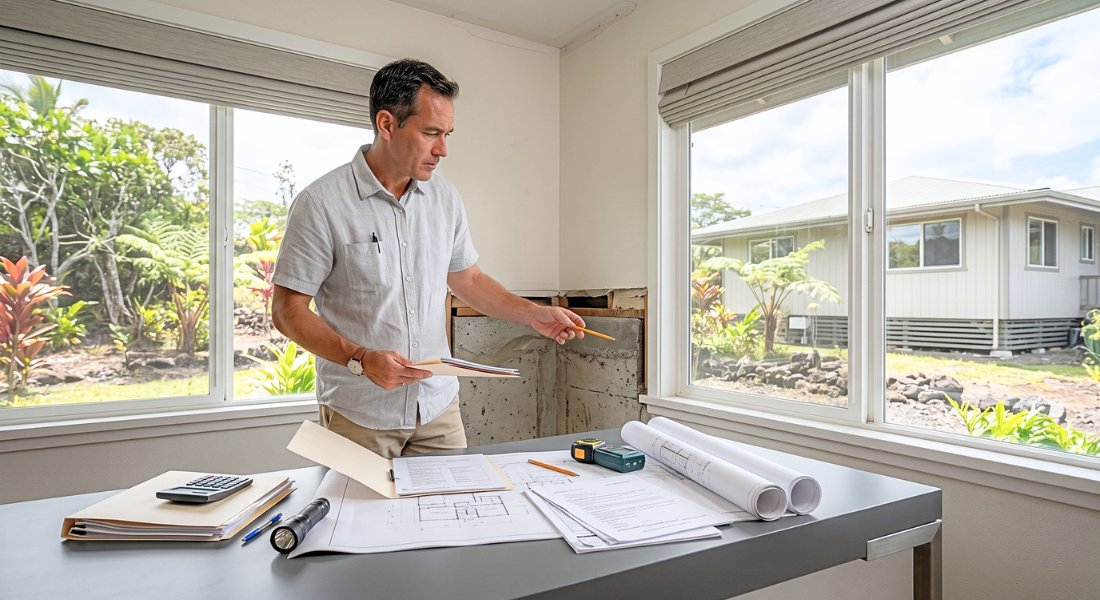
It's easy for buyers to get drawn in by the listing photos of homes on the Big Island. You see perfectly staged rooms and ocean views that catch your attention right away.
What those listing photos don't show you can be even more important. You won't see the concrete patch from the 2006 Kona earthquake, the open permit in county records, or moisture hiding behind fresh paint.
On the Big Island, the gap between what a listing presents and what a property actually is can cost buyers tens of thousands of dollars. No amount of scrolling through listing videos closes that gap. You need a builder's eye to see the subtle signs of what might be hiding a little deeper.
Big Island listing photos will show you what the seller wants you to see. What you won't find in the listing are foundation repairs, open permits, private water system issues, and microclimate realities that affect long-term ownership costs. A broker with a construction background reads structural history in real time and catches what listing sheets and home inspectors often miss.
A Builder's Eye Sees More on a Big Island Walkthrough
Builders know more about how properties are built and maintained over time. That experience lets them read a property's structural history in real time and look beyond its current presentation. It means recognizing past repairs, spotting signs of hidden remodeling, and understanding what construction details reveal about maintenance needs and true value.
I came to real estate through construction and design, and that background follows me through every property, driveway, and foundation. Where most agents see a staged living room, I naturally notice ceiling repairs and paint layers. I look for signs that work may have concealed a problem instead of correcting it.
When I walked the home I eventually bought for myself, I took a different approach than most people would. I skipped the home inspector, something I'd never recommend for a client, because I knew I could read the house myself.
I immediately identified that one ceiling had been painted and then sanded. I recognized the architectural series and suspected oak hardwood floors were buried beneath the carpet. When I pulled back the carpet, the hardwood was there as expected.
That's the difference: not just seeing what's there, but knowing what should be there and recognizing the gap between the two.
"I don't want to say I have 3D vision, but it's like seeing remodels. Why was this repaired? That leads me to look at the foundation and see if the dirt's been worn out underneath it. You can almost tell that a concrete repair is 20 years old. I see a little bit more history than just the current owner's usage." – Jonathan Brooke, Owner and Principal Broker, Kohala Brokers
Why Does Earthquake History Matter to Big Island Buyers?
The 2006 Kona earthquake is an important reference point when evaluating older Big Island homes. Many properties in affected areas sustained foundation damage. Repairs ranged from professional, FEMA-assisted work to owner-managed fixes of varying quality.
Knowing how to date a concrete patch and ask who repaired it, and why, is the kind of evaluation listing photos cannot provide. A concrete repair from 2006 looks different from one made in 1995.
This is one reason the Hawaii County Building Division permit record is worth pulling before a serious offer. Permit records can show when work was performed, what was inspected, and whether it was finalized. They do not tell the whole story, but they provide an important starting point.
Honest Representation Changes a Buyer's Experience
Buyers on the Big Island can spend hours studying listing photos and videos before seeing a property in person. That information can tell you if a home is worth a closer look, but you need to see more. Pick up the phone, walk the perimeter, and turn the camera around. Look at every view, cupboard, and place where moisture might hide.
The goal is to get as complete a picture as possible before making an offer. A transaction ends at closing, but a buyer's relationship with the property can last twenty years. The neighbors know things, and the structure knows things.
That same responsibility extends to permits. Open permits are common in Hawaii, and resolving them requires familiarity with contractors, engineers, and county offices.
I've coordinated inspections, tracked down the original engineer on a decades-old wastewater system, and personally delivered documentation to push a final permit through. It may not technically be the broker's job, but it can be the fastest path to a clear close.
Are you evaluating a Big Island property? Reach out to the team at Kohala Brokers before you make an offer. We'll help you with a thorough walkthrough that tells more of the story.
What Happens When Complexity Goes Beyond the Structure?
The foundation can reveal a lot about a home, but there are problems that go beyond the physical structure. Some problems show up in the title chain.
I recently closed a transaction involving a title cloud reaching back to 1857. The ownership break involved two historical transfers involving women who predeceased their husbands before the law firmly protected their inheritance rights.
Most brokers would have walked away, but I stayed because I believed in the property's value and trusted that a solution existed. I knew I just needed to put in the work to find it.
The work involved researching how a nearby parcel in the same title chain had been cleared through a quiet title action. It also required building a documentation trail and handling pressure from a competing buyer. I also needed to find a title company willing to provide insurance.
"We had to navigate. I don't want to say shark-infested waters, but it was a very rocky coast to bring that vessel into harbor. At first we didn't think we'd be able to do it. But as things got cleared, we realized: holy moly, we've done it." – Jonathan Brooke, Owner and Principal Broker, Kohala Brokers
The Listing Price Doesn't Tell the Whole Story
A listing price reflects a seller's expectations and a particular market moment. It doesn't capture foundation repairs, open permits, private water system costs, cesspool conversion timelines under Hawaii's Act 125, or the microclimate of a specific hillside. On the Big Island, those factors can significantly affect a property's true value and long-term ownership costs.
Water system type alone can change the math on a rural Big Island property by tens of thousands of dollars. Key considerations include:
- Catchment tank capacity
- Filtration requirements
- Potential shared-system connections
- Maintenance and operating costs
Microclimate variation within a few miles can also mean the difference between adequate rainfall and running dry during a drought year.
A construction background provides the vocabulary to evaluate these issues. More than two decades of island residency provide the context to interpret what that experience reveals. Together, they can produce something a listing sheet cannot: a clear picture of what a property is and what ownership will mean.
FAQs About Big Island Home Evaluations
What does a "builder's eye" mean in real estate?
A builder's eye means assessing structural condition, repair history, and construction quality through hands-on experience. It includes recognizing past remodeling and identifying the age and quality of concrete repairs. It also means understanding what construction details suggest about maintenance needs and true value. On the Big Island, that perspective can add context beyond a standard walkthrough.
What is an open permit, and why does it matter?
An open permit means a permitted project was never fully inspected, finalized, or signed off. That can complicate a closing, financing, or future sale. Future owners may also become responsible for bringing unpermitted or unfinished work into compliance. Open permits are common in Hawaii and may require follow-up with county offices, contractors, or engineers.
How does the 2006 Kona earthquake affect Big Island property evaluations today?
The 2006 earthquake caused foundation and structural damage across a wide range of properties. Repair quality varied, with some work professionally certified and other repairs managed by owners. Properties in affected areas may still carry issues that do not appear in listing descriptions. Knowing the earthquake's geographic footprint and how to date concrete repairs can help buyers ask better questions.
What is a title cloud, and how can it affect a Hawaii property sale?
A title cloud is an unresolved claim, lien, gap, or inconsistency in a property's ownership history. It can prevent standard financing, complicate a sale, or affect marketability. Resolving one may require legal research, documentation, and coordination with a title insurance company. For complex title issues, a qualified Hawaii real estate attorney is the appropriate resource.
Why do many Big Island properties have private water systems?
Much of the Big Island sits outside municipal water service areas, particularly in rural Kohala and upcountry Kona. Properties in these areas may rely on catchment systems, private wells, or shared water sources.
Buyers should understand the system's type, capacity, maintenance history, and legal status before purchasing.
What should mainland buyers know before purchasing on the Big Island?
Hawaii real estate involves infrastructure realities that differ from many mainland markets. These include:
- Private water systems
- Cesspool conversion requirements
- County permitting timelines
- Microclimate variation
- Community dynamics that can affect livability
A broker with long-term island experience can help surface these factors before they become post-closing surprises.
Does microclimate affect property value on the Big Island?
Yes. The Big Island contains multiple climate zones within relatively short distances. Elevation, trade wind exposure, and orientation can create major differences in rainfall and conditions. Microclimate affects water catchment yields, agricultural potential, construction material longevity, and long-term ownership costs.
What role does a title insurance company play in a complicated Hawaii closing?
Title insurance protects buyers and lenders against undiscovered claims or defects in a property's title history. When a title cloud exists, the title company evaluates the risk of insuring clear title. That may require legal documentation, court proceedings, or a quiet title action. Not all title companies will insure every situation. Finding one willing to underwrite a complicated title scenario is itself a significant part of resolving a difficult transaction.
Ready for a Walkthrough That Tells the Whole Story?
Big Island real estate rewards buyers who ask better questions. Listing photos and asking prices reflect one version of a property. The structure, the permit record, the water system, and the title chain often tell a different one.
Start the conversation with Kohala Brokers to get an honest read on properties on the Big Island. We'll use our experience to help you reveal the complete picture.