

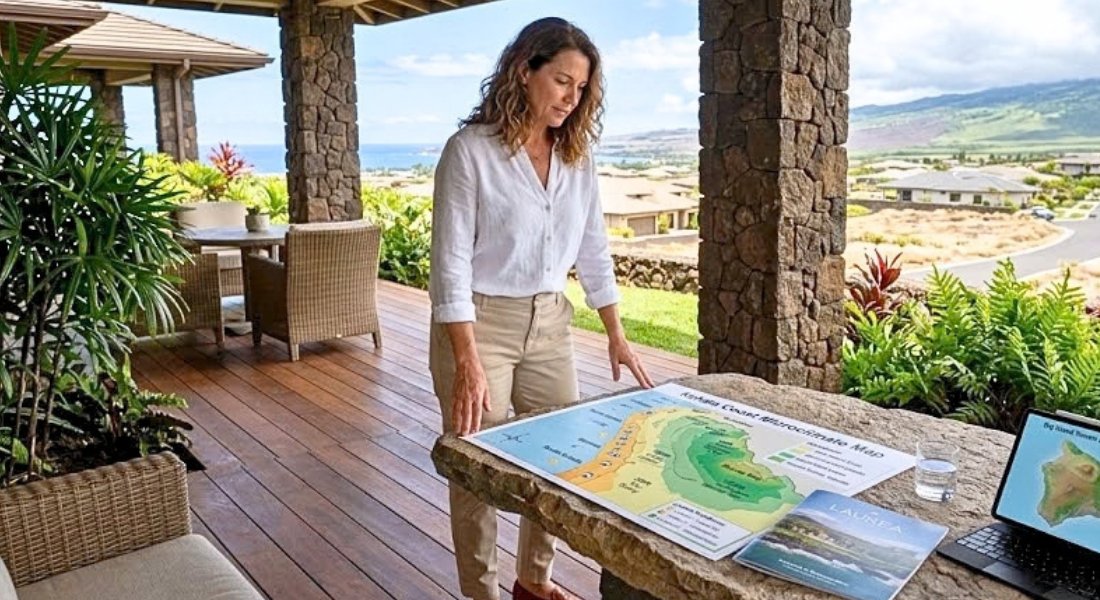
The Big Island of Hawaii contains a diverse range of climates. You'll find snow on Mauna Kea, barren lava fields baking under cloudless skies, and jungle properties with high rainfall. All of this exists within an hour's drive of each other.
For buyers who fall in love with a property before they understand which microclimate it sits in, that oversight can take years to undo. That's why microclimate is one of the first things you should discuss with your agent.
The Big Island spans eleven distinct climate zones. The one your property sits in shapes everything from your commute to your water system to whether you see sunrise or sunset from your lanai. Matching a buyer to the right microclimate is often the most important conversation in Big Island real estate. Getting it wrong means years of friction, no matter how beautiful the listing photos looked.
Desert, Jungle, and Near-Arctic on One Island
The geographic extremes here are not subtle. The Kona and Kohala coastlines on the leeward west side are dry, sunny, and oriented toward sunset views. Cross to the windward east side and the landscape shifts into dense jungle and dramatically higher rainfall. Both are beautiful in their own right, but they offer fundamentally different living environments.
Geographers identify as many as eleven distinct climate zones on the Big Island of Hawaii. That's more than almost any other comparably sized landmass on Earth. This variety is part of what makes the Big Island extraordinary. It is also what makes a casual "we loved the place we saw online" approach to property shopping risky.
The Big Island microclimate a property sits in determines sun exposure, rainfall, vegetation, temperature range, and community character. It also determines infrastructure: water systems, road conditions, and how far essential services actually are.
The Buyer's Lifestyle Determines the Map
The right qualification conversation has nothing to do with price range, and everything to do with lifestyle. The questions seem simple on the surface:
- Do you need to commute, and how far are you willing to go?
- What do you want to do with your free time?
- Are you looking for sunrise views or sunsets?
- Do you want more land at a lower price point, or proximity to amenities in town?
The answers to those questions not only narrow the map, but they also surface practical realities like water systems and infrastructure.
"What do you like to do? Do you like to watch the sunset or the sunrise? Because they're far apart. It is a big island. It only takes driving through a couple of areas for somebody to really get it. It's kind of like food tasting: if you have a physical reaction of 'that's bitter' or 'that's sweet,' that tells me a lot. I can have a qualifying conversation with somebody pretty quickly and understand where they belong." – Jonathan Brooke, Owner and Principal Broker, Kohala Brokers
If you love watching sunsets, you need the west side. If your work is centered in Kona, living on the east side could mean an hour and a half of driving each direction. These are quality-of-life decisions that compound over years.
Big Island Microclimates Influence Property Water Systems
The microclimate conversation connects to infrastructure, and this is where mainland buyers consistently get surprised. Understanding water systems before you start touring is essential. It is the kind of detail that determines whether a property actually fits your life.
On the wetter east side, many properties run on catchment systems: rainwater collected off the roof, filtered, and stored in tanks. It works, and for the right buyer it is perfectly manageable. But for someone who grew up expecting municipal water just to be there, maintaining a catchment system is a new category of homeownership responsibility. It requires attention, maintenance, and a different relationship with water than most buyers have ever had.
The Hawaii Department of Health's rainwater catchment guidelines outline treatment and testing standards. If you're considering a home with a catchment system, you should understand these standards before making an offer.
On the drier west side, municipal water serves most properties. But certain communities operate on private water systems with costs that surprise buyers who see inexpensive land and assume simple economics. At Kohala Ranch, for example, a pool, irrigation, and normal household use can push monthly water costs to $500 or more. That is not a dealbreaker for the right buyer. But it is the kind of detail that needs to surface in the first conversation, not at closing.
This is where lived experience matters as much as professional expertise. During a personal search for a home in North Kohala, I looked seriously at properties on the more affordable east side. I eventually decided against it because my work commute to the west side would have been too long.
You can learn more in our recent post on what buyers need to know about Big Island water systems. It covers the three types of systems buyers encounter and how they affect the ownership experience.
Not sure which side of the island actually fits how you live? Reach out to my team at Kohala Brokers before you start touring properties. A twenty-minute conversation about lifestyle can save months of looking in the wrong places.
Understanding the Big Island's Climate Classification System
Not all microclimate distinctions show up in a listing or a drive-by. The Köppen climate classification system identifies zones ranging from tropical rainforest on the east side to semi-arid on the Big Island. When you understand the climates, a property's elevation, and its orientation, you can start drawing conclusions before you even arrive.
Elevation alone shifts conditions dramatically. North Kohala sits at a moderate elevation with consistent trade winds and a cooler, greener character than the Kohala Coast below it. Waimea, also known as Kamuela, sits higher still and runs distinctly cooler and mistier than either.
FAQs About Big Island Microclimates and Real Estate
What is a Big Island microclimate and how is it different from general Hawaii weather?
A microclimate is a localized climate zone shaped by elevation, topography, volcanic terrain, and proximity to ocean or trade winds. On the Big Island, these conditions compress eleven distinct climate zones into a single island. General Hawaii weather patterns describe the state broadly. But on the Big Island, conditions shift from dry and sunny to dense jungle to near-freezing within an hour's drive.
How many climate zones does the Big Island have?
Geographers identify as many as eleven distinct climate zones on the Big Island. No other comparably sized landmass concentrates that range in one place. Each zone has distinct rainfall totals, temperature patterns, humidity levels, and land character. These factors affect property maintenance requirements, water infrastructure, and lifestyle fit in ways buyers need to understand before choosing a location.
How does water cost vary across Big Island microclimate zones?
Water costs vary significantly by location and water system type. Properties in wetter east-side zones often rely on rainwater catchment systems. On the drier west side, most properties connect to municipal water. Private community systems in areas like Kohala Ranch can push monthly costs to $500 or more for typical household use plus irrigation and a pool. Buyers focused on land price alone sometimes overlook these ongoing infrastructure costs entirely.
Is the west side or east side of the Big Island better for buyers?
Neither side is objectively better. The west side, including Kona and the Kohala Coast, is drier, sunnier, and oriented toward sunset views. It also has better access to amenities and municipal infrastructure. The east side offers a dramatically different landscape, higher rainfall, and generally lower price points, but with different infrastructure realities and longer commutes to Kona. The right side depends entirely on how a buyer intends to live, work, and move through the island.
How long does it typically take to find the right property on the Big Island?
There is no standard timeline. Some buyers find the right fit quickly; others take considerably longer as they learn the island and clarify what they want. An experienced advisor treats the process as one of elimination and refinement rather than a race to close. Every property that doesn't fit sharpens the understanding of the one that will.
What commute realities should Big Island buyers factor into their microclimate decision?
Distances on the Big Island can be longer than you expect. Living on the east side and working in Kona can mean a commute of an hour and a half or more in each direction. Communities like Waimea, North Kohala, and the Kohala Coast differ meaningfully in character, elevation, and proximity to services. Driving the actual routes at commute times before committing to a location is one of the most useful things a buyer can do.
Can I understand a Big Island microclimate from listing photos or virtual tours alone?
Listing photos show a property at its best on a good day. They do not show the cloud cover that rolls in by noon at certain elevations or the trade wind patterns that make some west-side locations breezy. They also don't show the road conditions that change character in rainy weather. Virtual tours are useful for evaluating interior layout and finish quality. They cannot replicate the physical experience of standing in a place and understanding what the light, the air, and the surrounding environment actually feel like. Visiting the area, at different times of day and in different weather, is the only reliable way to evaluate microclimate fit.
What should I ask a Big Island real estate broker before starting my property search?
Ask about their depth of local knowledge beyond listings. Talk about infrastructure, water systems, Big Island microclimate differences, and community character. Ask whether they have personally lived across different parts of the island. A broker whose knowledge runs deep enough to qualify buyers by lifestyle fit, not just price range, is worth finding before the search begins. For a related read, check out our post about what you won't see in listing photos and the value of a broker with building experience.
Start With the Right Conversation
Buying property on the Big Island is not the same decision in every zip code. Rainfall, water systems, commute patterns, community character, view orientation, and elevation all shape what daily life actually feels like. A property that looks perfect in listing photos can be the wrong fit if the surrounding microclimate doesn't match how someone actually lives.
The right location on the Big Island isn't always obvious. You need to assess your lifestyle and how it fits with different microclimates and communities. Reach out to the Kohala Brokers team to have that conversation.