

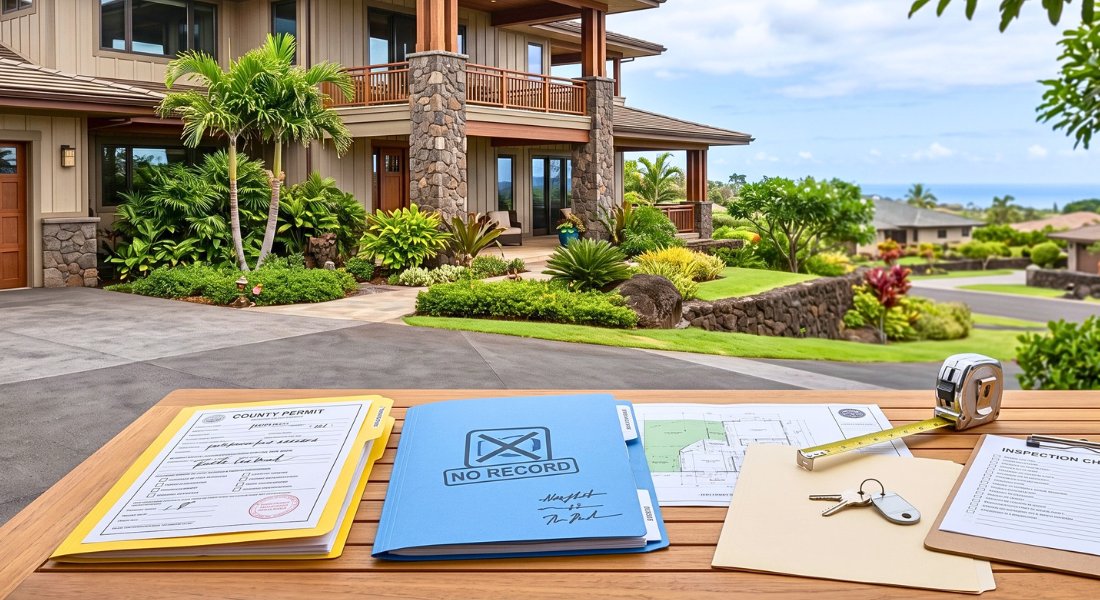
Most mainland buyers encounter Hawaii open permits the same way: buried in a disclosure form during escrow, three weeks before a planned closing. By then, every option costs more.
Understanding how open and missing permits work on the Big Island before you write an offer gives buyers a clear advantage. It can strengthen their negotiating position before problems surface.
An open permit means work started under county approval but never received a final inspection. A missing permit means work happened without any county involvement. Neither automatically kills a deal, but each carries different risks. Knowing the difference before you write an offer changes your negotiating position entirely.
What Open Permits Mean in Hawaii Real Estate
When you find an open permit on a property, it means work started under county approval but never received a final inspection. A missing permit means work happened without any Hawaii County involvement. Both can show up in disclosure forms. Neither automatically kills a deal, but each carries a different level of complexity.
Some open permits are administrative loose ends. A contractor finished the work correctly, never scheduled the final inspection, and moved on. With the right relationships and documentation, those situations can often be resolved in a matter of weeks. Others require engineering assessments or resubmitted plans. In the most difficult cases, it may require excavation of the work.
Open Permits Can Shift Leverage
Open-permit situations can shift negotiating leverage in measurable ways. A cash buyer has more flexibility to absorb the cost and timeline of remediation than a buyer requiring financing. Lenders may require clean permits before funding. Cash buyers don't carry that constraint.
Sellers who know they have an open permit before listing have a stronger position than those who discover it during escrow. They can price accordingly or remediate proactively rather than negotiating under deadline pressure.
I've represented sellers in multiple situations where an open permit on a wastewater system threatened to derail closing. In many of these cases, we resolved issues through existing relationships. Knowing which contractor did the original work fifteen years prior can make a difference. Having a direct line to the engineer and knowing what documentation the county needs can also speed resolution.
If you don't have those relationships, you might need to hire a permit runner. These professionals aren't cheap to hire, and they work on their own timeline.
A buyer's agent who understands Hawaii's permitting realities can identify these situations early. That creates room to negotiate repair credits, extended escrow periods, or add seller remediation as a condition of purchase. It is far better than discovering the problem at the eleventh hour, when every option costs more.
Not sure what a property's permit history means for your financing or your timeline? Talk to my team at Kohala Brokers before you write an offer. An early conversation keeps more options open.
A Real Open Permit Issue on the Big Island
One situation always comes to mind when I discuss open permits. It was the first Tesla solar roof installed on the Big Island, on a $7 million property. Coordinating with the solar installer and Hawaii County required persistence and strong relationships. The buyer's timeline added pressure to the transaction.
"The first Tesla roof built on this island never got final, and everybody thought it was done. And a buyer's buying a $7 million property; they want to make sure that final is complete by the time they close. Some open permits can be rectified easily. Some are going to be a challenge, like digging up stuff, or engineering, or resubmitting paperwork." – Jonathan Brooke, Owner and Principal Broker, Kohala Brokers
The final did get issued, and the deal closed. But it was only possible because of existing relationships and persistence. This kind of issue does not sort itself out.
Having a Construction Background Changes the Permit Review
My construction background changes how I approach permits before the disclosure forms even arrive. When I walk a property, I see indicators that I need to look deeper. It might be a repaired foundation corner that reads as earthquake work from 2006, or a ceiling showing evidence of two paint treatments. I might see a drainage pattern that suggests an addition built without proper grading review.
The Big Island's 2006 Kona earthquake left structural signatures on hillside properties across Kohala and Kona. Recognizing those signatures on a walkthrough, before the permit history arrives, separates proactive evaluation from reactive discovery.
"I don't want to say I have 3D vision, but it's like seeing remodels. Why was this repaired? It kind of leads me to look at that. You can almost tell that concrete repair is twenty years old. That's from the '06 earthquake. Did FEMA step in? Was it a homeowner repair?" – Jonathan Brooke, Owner and Principal Broker, Kohala Brokers
Hawaii County's Permitting Process and What Buyers Can Research
Big Island properties fall under Hawaii County's permitting jurisdiction. The county has made its electronic information system more accessible in recent years. Buyers can now research permit histories with more transparency than was available even a decade ago. That research is a useful starting point and covers most of what you need to know for most properties.
For complex situations, having someone with existing county-level relationships can significantly reduce resolution time. These situations can include unpermitted additions, older wastewater systems installed before modern Environmental Protection Agency standards, and solar installations with incomplete interconnection paperwork.
The Uniform Standards of Professional Appraisal Practice (USPAP) don't require appraisers to flag unpermitted work explicitly. That means permit problems can survive an appraisal and surface only during lender underwriting. Another reason to identify them before escrow opens.
Properties on larger lots, common in Kohala and Kona, sometimes carry a long history of improvements made by multiple owners over decades. A thorough permit review at the offer stage is not extra diligence. It is basic diligence.
Common Questions About Open Permits in Hawaii Real Estate
What is an open permit in Hawaii real estate?
An open permit means a property owner or contractor obtained county approval but never completed the required final inspection. The work may be finished correctly; the paperwork simply wasn't closed out. Open permits appear on Hawaii disclosure forms and can affect financing, title transfer, and negotiating leverage if left unresolved before closing.
What is the difference between an open permit and a missing permit in Hawaii?
An open permit was properly pulled from the county but never closed. A missing permit means the work was done without any county involvement: no application, no inspection, and no record. Missing permits generally carry more risk because there is no documentation to build from. The county also has no record of the work's scope or quality.
Do open permits prevent a home sale in Hawaii?
Not automatically. Many open permits can be resolved with a final inspection, updated documentation, or minor corrective work. Complexity depends on the type of work the permit covers, how old it is, and what the lender requires. Cash buyers have considerably more flexibility than financed buyers. Financed buyers may face lender conditions that require permit resolution before funding is approved.
Who is responsible for resolving open permits, the buyer or the seller?
Responsibility is negotiable. Sellers who disclose an open permit before listing can price accordingly or remediate proactively. Buyers who discover an open permit during escrow can negotiate repair credits, seller remediation, or an extended escrow period as a condition of closing. The party with the most information and the least time pressure generally holds more leverage.
Can a general home inspection reveal permit issues on the Big Island?
A general home inspection might flag work that appears unpermitted, such as additions without proper grading or structural repairs. It may also identify mechanical systems that don't match the disclosed square footage. An agent with a construction background can often identify physical indicators of unpermitted work during a walkthrough. Identifying these issues early creates meaningful negotiating room and avoids eleventh-hour surprises.
What types of unpermitted work are most common on Big Island properties?
Unpermitted Ohana units are among the most common. Other examples include unpermitted additions, agricultural structures converted to living space, and older wastewater or septic systems installed before modern permitting requirements. Properties on larger lots in Kohala and Kona sometimes have a long history of improvements made by multiple owners over decades. That makes a thorough permit review at the offer stage especially important.
How long does it take to resolve an open permit in Hawaii?
Simple administrative closures, such as scheduling a missed final inspection or submitting updated documentation, can sometimes resolve in weeks. More complex situations involving engineering review, resubmitted plans, or physical remediation work can extend timelines by months. The biggest variable is whether the relevant contractors, engineers, and Hawaii County contacts are accessible and responsive.
What happens to an open permit during a title search in Hawaii?
Open permits can surface during a title search and create what's called a title cloud. This condition can complicate or delay the transfer of clear title. Title insurance companies will flag unresolved permits, and some will exclude coverage related to unpermitted work. Buyers should understand that a title policy doesn't automatically protect against all permit-related liability. That makes early permit review a practical necessity rather than an optional step.
Reading a Property's Real History Before You Offer
Permit issues on the Big Island are common enough that experienced buyers should expect to encounter them. Hawaii County's permitting office has improved its systems considerably, and remediation options exist for most situations. The deals that fall apart over permits are usually the ones where nobody asked the right questions early enough.
Are you evaluating a Big Island property and want to understand what the permit history means for your timeline, your financing, and your negotiating position? Start the conversation with Kohala Brokers before you're under contract.