

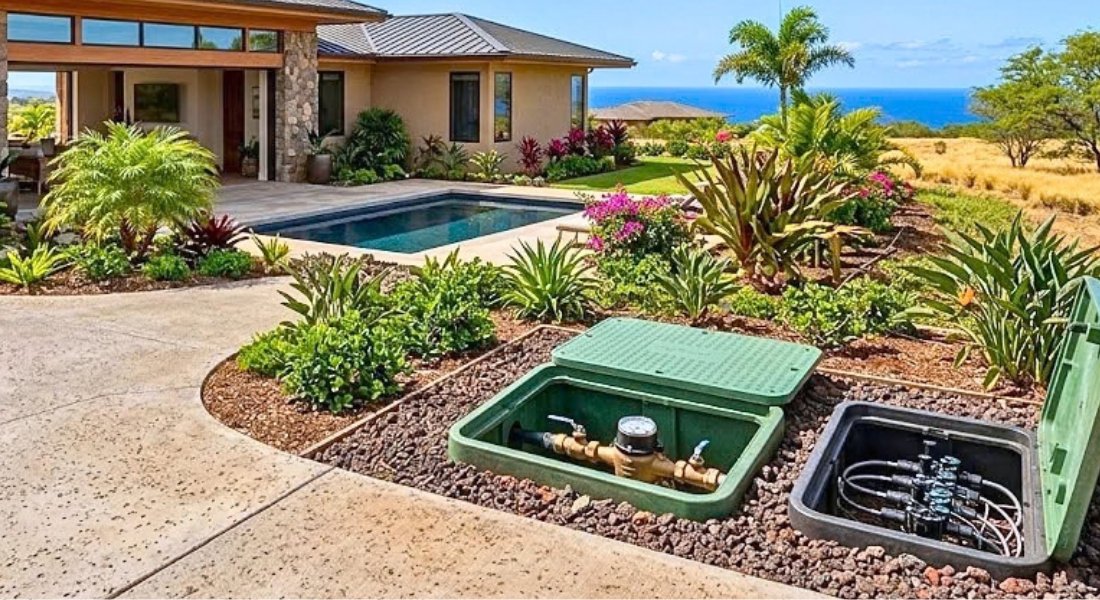
Most mainland buyers shopping for Big Island property run the same mental math: square footage, lot size, price per acre, distance to the beach. Water rarely makes the list, but that omission can be expensive.
Big Island water systems vary so dramatically across communities that monthly costs can swing from $30 to over $600. It all comes down to which type of system serves the parcel you are considering.
The Big Island runs on three distinct water systems: municipal, catchment, and private. Each carries different costs and responsibilities. Knowing which system serves a property before you write an offer is as important as knowing the asking price. A single conversation with a local broker can provide clarity before you write an offer.
The Types of Water Systems on the Big Island
The type of water system a property has is more important than most mainland buyers expect. Each type has its own costs and can significantly influence the ownership experience. That's why it is essential to determine the type of system a property has early in the process.
Municipal water is what most buyers expect and, on the west side of the island, what most of them get. Leeward Kohala and Kona communities run largely on municipal service. Monthly bills are typically modest. Think $30 a month, predictable and unremarkable in the best possible way.
The east side of the island receives enough rainfall that many properties can collect enough water from their roofs. That's where catchment systems become an option. You just need to run the water through a filtration system to have a usable water supply.
Once established, the catchment systems can be reliable and relatively low-cost to operate. That said, it introduces a layer of personal responsibility that surprises buyers accustomed to turning on a tap and never thinking about what comes next. You might have drought years that require water delivery. The system also needs periodic maintenance.
Private water systems are where the real sticker shock lives, and where buyer confusion runs deepest.
Why Is Water So Expensive in Some Kohala Communities?
Certain large planned communities in the Kohala region, including Kohala Ranch and Kohala by the Sea, operate on private water infrastructure. The system works on independent networks of wells and pump stations engineered to move water across thousands of acres and significant elevation change.
That engineering costs money to maintain, and those costs pass directly to property owners.
When buyers come in excited about affordable land prices, the conversation must move to the full picture of what ownership costs.
"I see people come in and say, 'Wow, look, this land is so cheap. I can afford to build a house.' And then I have to have the discussion about how much it costs to build a house. If you go into Kohala Ranch with an irrigated yard and you're just a normal person, not a wasting person, you're going to have a $300 to $500 a month water bill. If you have a pool and irrigation, you'll hit $500 to $600 easily." – Jonathan Brooke, Owner and Principal Broker, Kohala Brokers
A lot priced at $300,000 can look like a bargain until ongoing water costs reframe what ownership actually means over ten or twenty years. The job is to surface that number before a buyer falls in love with the listing.
Microclimates Change the Water Equation
Understanding Big Island water systems is inseparable from understanding the island's climate. This is not a place where one weather pattern applies everywhere.
The west side is dry and sunny, with reliably clear skies that fuel the sunset real estate premium. The east side is lush, with rainfall that makes catchment systems a practical solution rather than a compromise.
At elevation, the variables multiply further. Properties above 2,000 feet in Kohala sit in entirely different conditions than oceanfront lots in Kona. Buyers who have visited only one part of the island often arrive with assumptions that don't transfer to the neighborhood they are actually considering.
Experience across Kona, South Kona, North Kohala, and Kamuela makes it possible to help buyers understand these differences. Not just where they're looking now, but what daily life looks like across seasons in different microclimates. A listing description does not provide that context.
For more on Hawaii's water resource management, the Hawaii Commission on Water Resource Management maintains current statewide data on water availability and regulation.
Elevation Decides Which Water System You Get
Elevation affects both water source and water cost in ways that catch buyers off guard.
Higher-elevation properties in private subdivisions sit at the far end of pump infrastructure designed to push water uphill across considerable distance. That mechanical demand drives private system costs well above what mainland buyers consider normal. Lower-elevation properties closer to municipal infrastructure tend to have lower monthly costs.
The relationship between elevation and water bills isn't perfectly linear. But elevation combined with community type is a reliable indicator of where monthly costs will land. That is why reviewing the water arrangement for any parcel, not just the general area, belongs at the top of the due diligence checklist.
The Hawaii Department of Health's Safe Drinking Water Branch regulates water systems statewide. It publishes information on system types, compliance, and testing requirements that buyers in private-system communities should review before closing.
Not sure which water system serves the property you are considering? Schedule a conversation with the team at Kohala Brokers before you write the offer.
Water Due Diligence Steps For Buyers on the Big Island
Because water systems can swing ownership costs and affect day-to-day life, this must be a key step in due diligence. Here is what that looks like in practice:
- Confirm the water source for the specific tax map key (TMK) on the parcel, not just the subdivision name. Two adjacent lots can sit on different systems if they were platted differently.
- Ask the seller for copies of recent water bills. Three to six months of billing history reveals the actual cost range, including any seasonal spikes.
- For catchment systems, ask for documentation on tank capacity, filtration components, and any delivery contracts the current owner maintains.
- Factor water costs into your comparative analysis alongside property tax, insurance, and any homeowners association fees. A property that looks 20% cheaper than its neighbor may cost more to own once you account for water.
For properties in private-system communities, the Hawaii Public Utilities Commission regulates certain private water utilities. It maintains records that can help a buyer understand rate history and system oversight.
"It's not as mysterious as it sounds. Most areas are clear and affordable, with normal municipal water on about 90% of the listings I sell. But some areas don't have municipal water service. And then there's private water systems installed in certain communities. That water is very expensive. Somebody looking at an affordable lot in one of those areas needs to know what they're actually buying into." – Jonathan Brooke, Owner and Principal Broker, Kohala Brokers
FAQs About Big Island Water Systems
What are the three water systems on the Big Island of Hawaii?
The Big Island operates on municipal water, rainwater catchment systems, and private water systems. Municipal water serves most west side communities in Kohala and Kona. Catchment systems are common on the wetter east side. Private systems operate in specific planned communities and typically carry the highest monthly costs.
How much does private water cost in communities like Kohala Ranch?
Monthly water bills in private-system communities like Kohala Ranch typically range from $300 to $500 for standard residential use with irrigation. Properties with pools or heavier irrigation can reach $500 to $600 per month or more. This is substantially higher than municipal water, which runs around $30 per month for typical residential use.
What is a rainwater catchment system and how does it work?
A catchment system collects rainfall from a roof, channels it into a storage tank, and filters it for household use. These systems are common on the east side of the Big Island, where annual rainfall is high. They require periodic maintenance and occasional water delivery during dry periods. These systems work well for buyers comfortable managing their own water supply.
Does municipal water cover most Big Island real estate listings?
Municipal water serves most listings on the west side of the island, particularly in Kona and leeward Kohala communities. Some areas, including parts of North Kohala and certain large planned subdivisions, fall outside municipal service. Confirming a parcel's water source is a straightforward due diligence step that any knowledgeable local broker can handle quickly.
Why does the water system type matter when evaluating lot prices on the Big Island?
An affordable land price can mask significant ongoing water costs. A lot priced attractively in a private-system subdivision may carry monthly water expenses five to fifteen times higher than comparable municipal-served properties. Over a ten- or twenty-year ownership horizon, that difference becomes a meaningful financial variable.
Can I determine the water system type from a standard property listing?
Most online listings do not specify water system type clearly, and some may omit it. The listing may note "private water" or "catchment" in the utility fields, but details on costs, system age, and maintenance history require direct inquiry. A local broker familiar with the specific community can confirm the arrangement and its typical costs before you schedule a showing.
How does rainwater catchment water quality compare to municipal water?
When properly filtered and maintained, catchment water is safe for household use under Hawaii Department of Health guidelines. Most systems include multiple filtration stages. Buyers considering catchment-served properties should review the existing system components and confirm filtration specifications. It is also important to understand the maintenance requirements before closing.
Are there rules about how private water systems on the Big Island are regulated?
Private water utilities serving multiple properties fall under the Hawaii Public Utilities Commission. Smaller private systems serving only a single property or a handful of lots may operate outside PUC oversight, making due diligence even more important. Buyers should request system documentation and, when appropriate, consult a real estate attorney about ongoing obligations tied to private water agreements.
The Water Conversation Belongs at the Beginning
Water prices can vary significantly depending on the property, but the process doesn't need to feel daunting. Big Island water systems have clear patterns, and an experienced local advisor can map them out quickly for any property or community you are considering.
The team at Kohala Brokers brings decades of local experience to the infrastructure questions that shape Big Island ownership. If you are considering a specific property, contact us before you write an offer. We can help you understand the water system and the costs you should expect.