












 Jonathan BrookePrincipal Broker / Owner
 Alani GalantoTransaction Coordinator
 John ShepherdAgent
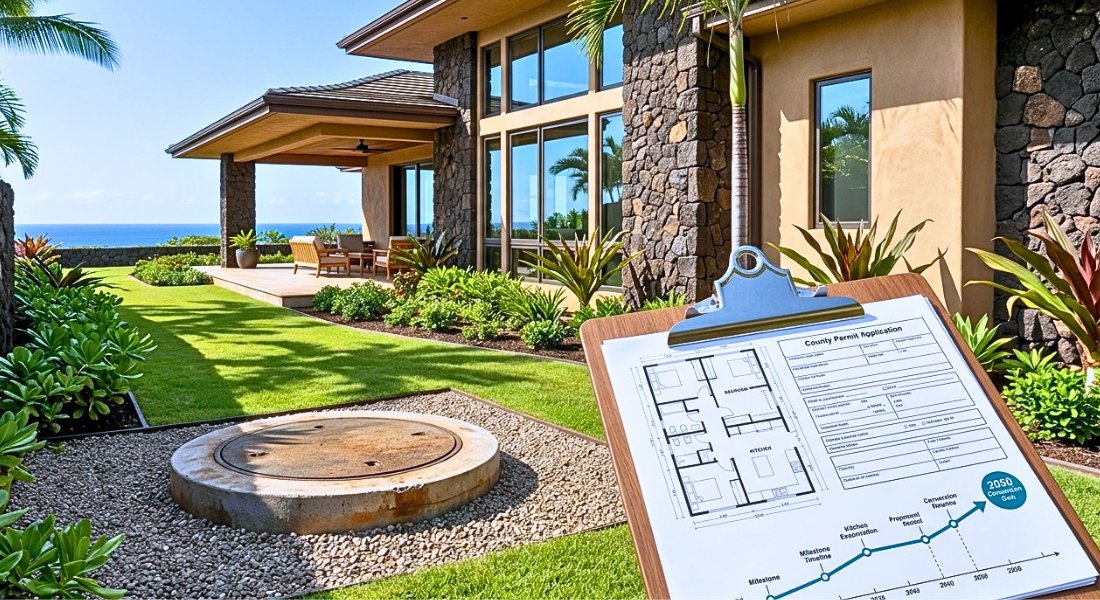
Buying property on Hawaii's Big Island and heard the word "cesspool" come up? It might sound worrying at first, but the situation is more manageable than it sounds.
Hawaii's cesspool conversion legislation ranks among the most consistently misunderstood regulatory factors in local real estate. Clarifying what the law actually requires, what triggers early action, and how cesspool status shapes a negotiation can save you real money and stress.
Hawaii's cesspool conversion law sets a 2050 statewide deadline, but that date is only one of two triggers Big Island buyers need to know. Any permitted improvement to a cesspool property can require immediate conversion regardless of the 2050 timeline. Buyers who understand both triggers enter negotiations better prepared.
The Basics of Hawaii's 2050 Cesspool Conversion Deadline
Hawaii once had a firm 2030 deadline requiring all cesspools statewide to convert to approved wastewater systems. Legislation later pushed that mandate out to 2050, a shift that meaningfully changed how buyers and sellers think about the issue.
The current cesspool law still requires conversion, but the timeline is long enough that many buyers conclude they won't need to act during their ownership. That assessment holds in many cases. But 2050 is only one of two triggers that matter, and that is where buyers may get caught off guard.
Permitted improvements can force a wastewater upgrade regardless of where you stand on the 2050 timeline. Buyers who plan to renovate need to know this before they write an offer.
How Cesspool Status Shows Up in Big Island Real Estate Negotiations
When a property has already converted from a cesspool to a septic system, buyers and their agents generally treat it as a selling point. The compliance question is answered, and there is one fewer variable in the transaction. Sellers who have made that investment can reasonably position it as added value.
When a property still has a cesspool, the calculus depends on several intersecting factors. You have to consider proximity to the ocean or environmentally sensitive areas, improvement plans, financing structure, and how far away any future sale might be.
"I have run into it with wastewater systems that were not finalized. In all three of the situations where I've represented sellers in that case, I've been successful." – JB
Those outcomes result from institutional knowledge that only comes from deep, long-term immersion in a specific market. It is a real advantage to know which contractors built which systems and which engineers still hold the drawings. It's something you can't get from a simple Google search.
Cesspools Don't Have to Kill Deals
An experienced broker can bring real context to these conversations. They provide a clear comparison of how cesspools and septic systems work, and what the outlook is for a given property.
A cesspool and a septic tank both process household wastewater. The main difference is that a septic system holds solids in a contained tank that requires periodic pumping by a licensed contractor. A properly maintained cesspool relies on natural biological processes to break down waste directly in the soil. Neither system is inherently bad for a buyer who understands what they're working with.
The Hawaii Department of Health's wastewater branch regulates both types of systems. County-specific requirements under the Hawaii County Code govern what triggers mandatory upgrades at the local level.
The more relevant long-term question, particularly in denser areas of Kohala and Kona, is whether expanding municipal wastewater infrastructure will eventually change the calculus. Some communities adjacent to existing treatment systems are already in early conversations about extending those lines. For a homeowner weighing a conversion investment of $15,000 to $45,000 or more, that question is worth raising before committing to an individual system upgrade.
Sorting out whether cesspool status should affect your offer price or your due diligence timeline? Talk to my team at Kohala Brokers before you write the offer. A short conversation at this stage can reframe the entire negotiation.
What to Do Before Making an Offer on a Cesspool Property
Taking a few early steps can help you understand a property's wastewater situation. Buyers should consider the following:
- Permit Status: Check the current permit status. Is the cesspool properly finalized with Hawaii County, or are there open permit issues? This surfaces during due diligence and is knowable before closing.
- Improvement Plans: Consider whether improvement plans could trigger a conversion requirement. If you intend to add a bedroom, expand the kitchen, or pull any county permits for structural work, build conversion costs into your budget.
- Proximity to the Ocean: Oceanfront and near-coastal properties face additional environmental sensitivity around wastewater systems. That can affect both the cost and complexity of any conversion under EPA guidelines for onsite wastewater treatment.
- Municipal Expansion: In some areas, the answer to cesspool conversion may be a utility hookup within the next decade rather than an individual system installation today. Look into whether the municipality has plans to expand the system.
Most of these points are easy to cover. You just need to take the time to factor them into your buying decision. Ideally, before the inspection period creates time pressure and before emotion clouds the numbers.
For a deeper read on the permit conversation, read our post about open permits in Hawaii. It covers why you may discover open permits on a property and steps you can take to resolve them.
Common Questions About Cesspool Conversions in Hawaii Real Estate
What is Hawaii's cesspool conversion deadline?
Hawaii requires all cesspools statewide to convert to approved wastewater systems by 2050. Local practitioners generally agree that any transfer of title will require compliance by that date. However, exact enforcement mechanisms are still subject to regulatory interpretation.
Does the 2050 deadline mean I don't need to worry about conversion for decades?
The 2050 deadline is only one trigger. Pulling a county building permit for any structural improvement can require a wastewater system upgrade regardless of the 2050 timeline. That could include an added bedroom, a kitchen expansion, or a major renovation. Buyers planning to renovate should factor conversion costs into their offer.
How much does cesspool conversion typically cost on the Big Island?
A general planning range is $15,000 to $45,000 or more for a standard residential conversion. However, that number moves based on site conditions, soil type, system size, and current permit status. Properties with complicated site access, rocky terrain, or proximity to the ocean can cost significantly more. Get a site-specific assessment from a licensed Hawaii contractor before budgeting.
Can a cesspool property be financed with a conventional mortgage?
In most cases, yes. A cesspool does not automatically disqualify a property from conventional financing. Lender requirements vary, and some loan programs carry stricter wastewater standards. Confirm your lender's requirements early in the process, before you are deep into escrow.
What happens if a wastewater system was built correctly but never finalized with the county?
This situation is more common than buyers expect and is not automatically fatal to a transaction. If the system was constructed properly, you may be able to finalize the permit retroactively. You'd need to work with the original engineer and contractor to submit the documentation to Hawaii County. In some cases, you may need to do minor physical work to allow inspection access. Resolving these situations requires local relationships and persistence.
How does a cesspool differ from a septic system under Hawaii regulations?
A septic system separates solids in a contained tank that requires periodic pumping, then disperses liquid effluent through a leach field. A cesspool discharges all wastewater directly into the surrounding soil for natural breakdown. Hawaii's Department of Health regulates both, but only septic systems and aerobic treatment units meet the current standard for new and upgraded installations.
Can a real estate agent help negotiate cesspool conversion costs into the purchase price?
Yes, and this is one area where Big Island market experience matters significantly. An agent familiar with actual conversion costs, permit history norms, and current contractor pricing in Kohala and Kona can help buyers structure requests during negotiations. With that context, you can ask for credits or price reductions that reflect the real costs. Generic estimates from the mainland rarely apply to Big Island site conditions.
What if the cesspool is near an ocean or sensitive environmental area?
Properties in coastal or environmentally sensitive zones face stricter scrutiny under both state and county wastewater regulations. Proximity to the ocean can increase conversion costs and complexity. In some cases, it can trigger earlier action than the 2050 deadline suggests. This is a question to ask any seller's agent and confirm with a local environmental contractor before closing.
Ready to Get Clear Before You Commit
Cesspool status does not have to be a source of stress in a Big Island transaction. Buyers just need to make sure they understand it as a variable in the transaction. Consider how it affects your offer strategy, due diligence timeline, and long-term ownership plan before you are emotionally committed to a property.
Kohala Brokers works through these questions with buyers and sellers across Kohala, Kona, and the surrounding communities. If cesspool status is part of your current conversation, reach out to our team for a straightforward assessment of your situation.